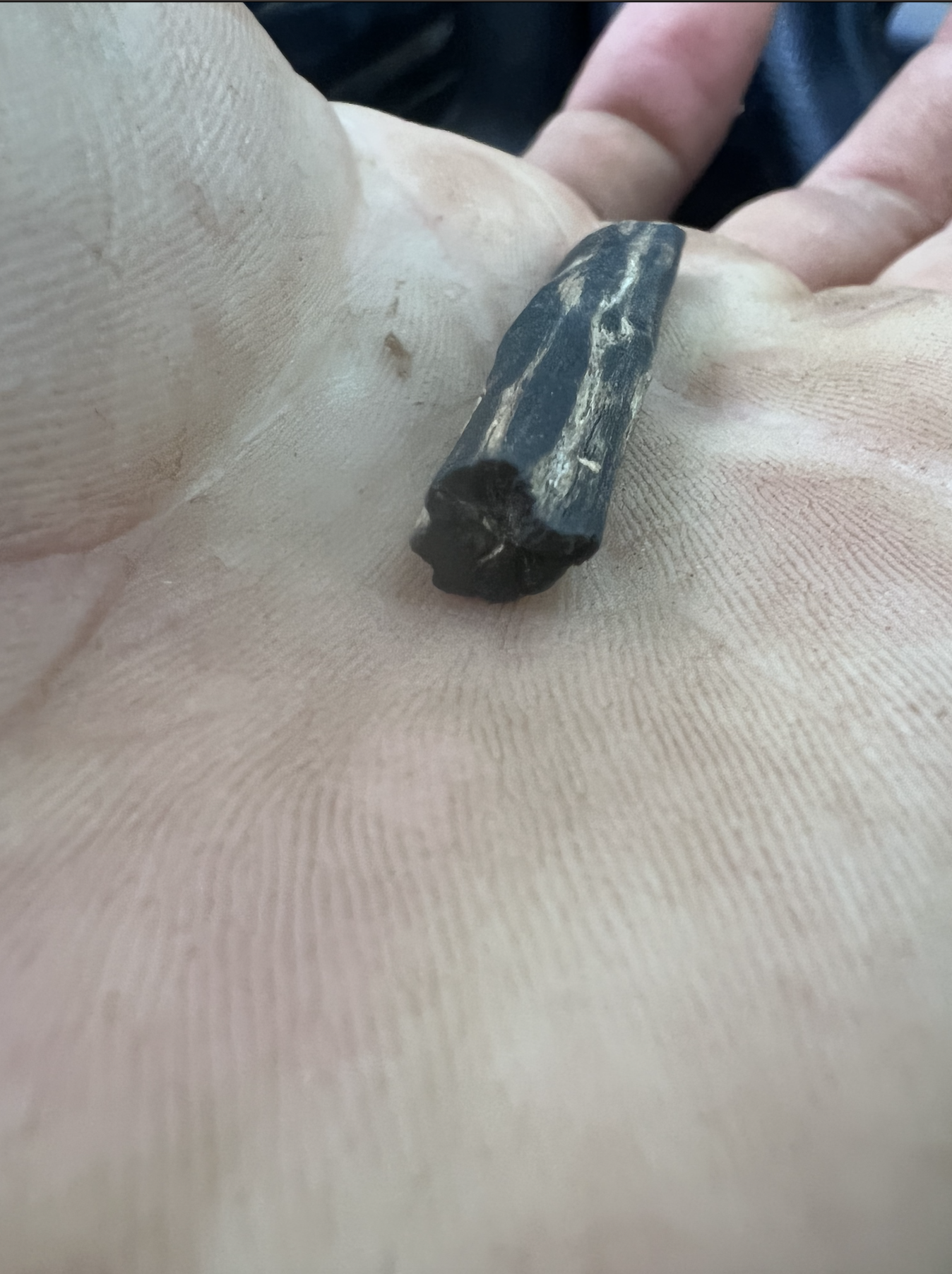
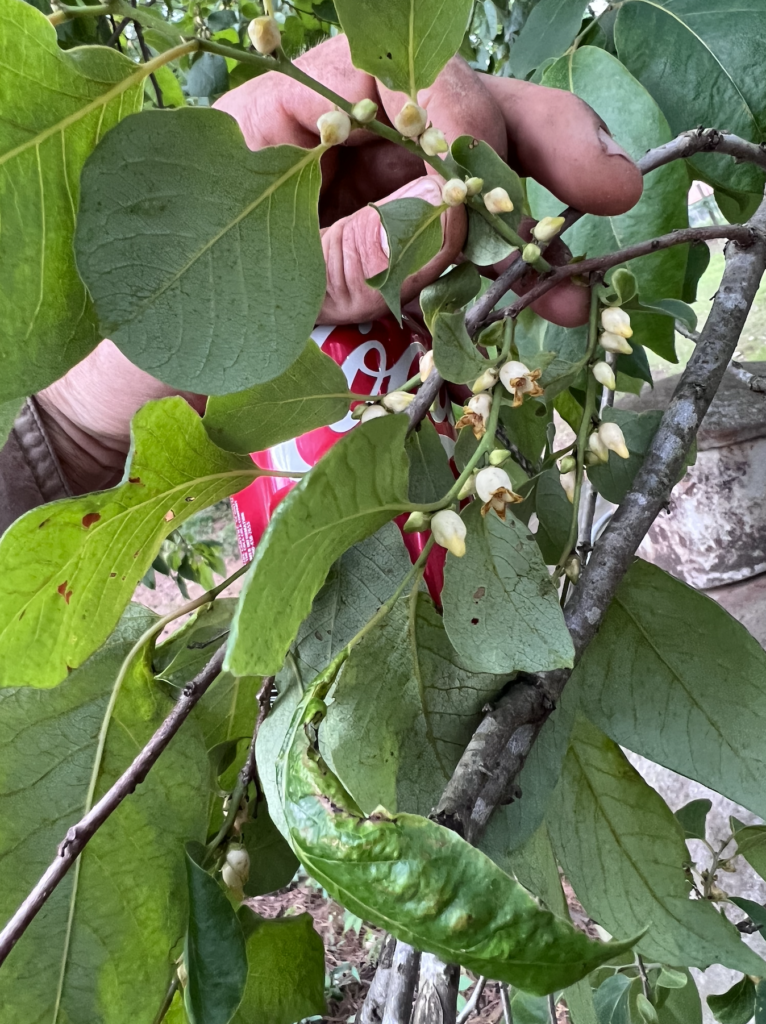
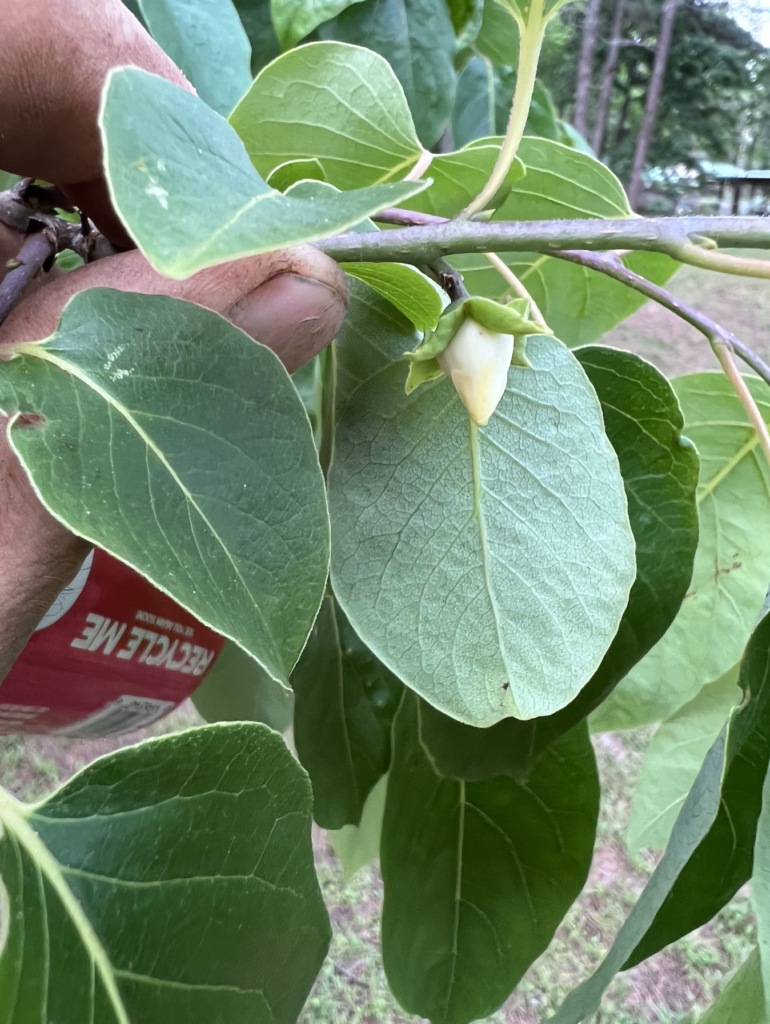
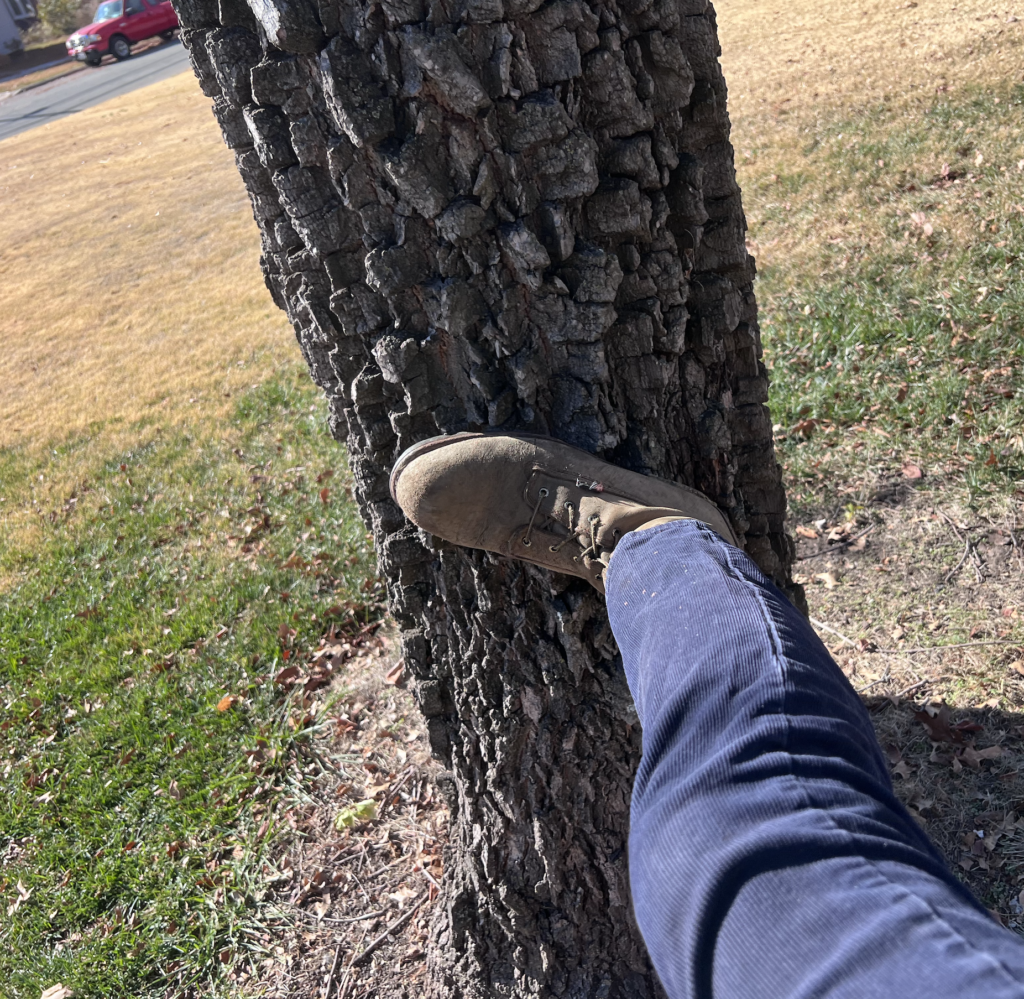
The American Persimmon, Diospyros virginiana, is a native true ebony with fruit that many people sincerely love. Native Amerindians made a dried fruit loaf of the pulp of this tree that was said to last for over a year, with dried fruit said to be far better than contemporaneous European plums.[i] SE tribes also made a beer when combined with honey locust pods, which was said to be superb. Seeds were ground into meal.[ii] On average, they will live to age 80, but commonly live to 150. Unfortunately, they rarely have a harvestable amount of heartwood until age 100. They’re a slow growing, medium sized dioecious tree. They are often susceptible to Anthracnose and webworms. Unsurprisingly, progeny tends toward 70-90% males, even though only around 10-25% of males need to be present for good seed set. Trees have either 60 or 90 chromosomes, tetraploid or sextaploid.[iii] They’re tolerant of many soils, but favor those with a Ph of 4.4-7.0[iv] There are two national champions: State: OH County: Scioto. Trunk Circumference: 157 inches Height: 87 feet Crown Spread: 46 feet Year Last Measured: 2013[v] State: VA County: Suffolk, Trunk Circumference: 152 inches Height: 85 feet Crown Spread: 68 feet Year Last Measured: 2015.[vi] Both are slightly over 4’. meaning they likely have 1-3’ of “true ebony” heartwood (which can be determined via dendrology.) The largest on my property died when it was 8”, and it had around .2” of heartwood for about 10’ of the trunk. At another property I was managing, a 2” male persimmon also had around .2” of heartwood. Heartwood tends to be tied less to growth or size but instead to individual age. To create a sustainable ebony industry, trees which live longer and trees which begin forming heartwood earlier in life are vitally important. Simultaneously, it is important to also focus on fruit production, for which much work has already been done.
American Persimmon is often a midstory tree, and can therefore tolerate high amounts of sunlight or shade. Most true ebony trees tend to be small to medium sized trees. I think it would be useful to try to find dwarf rootstocks in addition to searching for the biggest and oldest trees. It’s also useful to search for those with good self-pruning properties and straight growth. Most ebony trees are small trees but possess large amounts of heartwood and minimal sapwood. Ebony is interesting for its extremely low shrink ratio and exceptionally dark grain. It is often used for piano keys, guitar fretboards, guitar picks, woodwinds, chess pieces, and high end furniture. Ebony heartwood has been the world’s most expensive timber species for roughly 3,000 years. It is most commonly found in tropical African rainforests. Many sought after species are close to being functionally extinct. The current ebony industry necessarily subsidizes rainforest deforestation, as the high price it commands increases the economic motive to harvest other non-ebony species. Other general qualities to search for are earlier spring growth, drought resistance, and ease of transplanting — such as a flexible, shallow, or severable taproot. For the purpose of fruit production, machine harvest potential via a crop that ripens all at once for processing would be ideal. They will fruit at age 3 if grafted, age 5-6 if from seed. (Breeding work could likely be improved by grafting first year saplings onto established rootsocks.)
Much of the early work on American Persimmon fruit was performed by Elwyn Meader or James Claypool (obviously Amerindians impacted the tree before then). Meader produced the eponymous cultivar which is often cited as the best self-fruitful variant. There is, however, a possibility that this is a hybrid cross with Korean persimmons, owing to him spending his early career there. The first named variety was the “Early Golden”, a wild selected cultivar from Illinois in 1880. It was the parent of many later cultivars. Professor J.C. McDaniel from the University of Illinois, aided Mr. Claypool on his persimmon program, and is credited with selecting “‘John Rick’ and ‘Florence’. James “Claypool evaluated over 2,000 trees and kept extensive orchard records describing the characteristics of each tree in his breeding project. As Claypool’s health declined in the early 1990’s various members of the Indiana Nut Growers Association decided to carry on his work; one of those individuals was Jerry Lehman, who has a 60-acre orchard in Terra Haute, IN. He has been working with persimmons there ever since and has a large repository containing some of the most diverse American persimmon genetics in the world.”[vii]
James Claypool’s breeding criteria were as such:
- Reduce the long ripening period
- Improve fruit size
- Calyx holding to fruit when dropping from the tree
- Increase the already wonderful flavor
- Skin tough enough to hold fruit when it strikes ground
- Better the color of skin or attractiveness
- Reduce seed numbers
- Eliminate black spots in fruit flesh
- Improve pulp color & longevity when frozen
I think a few other additions ought to be included:
- Smaller seeds, or anueploid parthenocarpy
- Bagworm resistance, Anthracnose resistance
- Male with medium sized pollen, or variable sized pollen, and long pollination period, males with good female parentage, extremely old males
- Early formation of heartwood
- ‘Prok’ “we’ve seen and tasted samples that look ripe, feel ripe, lack any astringency, but taste bland and borderline insipid.”[viii] (35′-60′ tall, August-Oct ripening, cold hardy, from Cornell seedling.)[ix]
- Meader (released 1985, self-fruitful, 35’. Seedless if not pollinated. “cold-hardy, surviving to at least -25 degrees F, and adapted to regions with cool summers. Fruit ripens early but loses it astringency slowly.”[x])
- Yates (self-fertile, discovered by Ed Yates of Cincinnati, OH. Won first place at the Mitchell Persimmon Festival in 1983.)[xi]
[i] Two promising fruit plants for northern landscapes by Edward goodell
[ii] Two promising fruit plants for northern landscapes by Edward goodell
[iii] H ORTSCIENCE 55(1):4-7. 2020. https://doi.org/10.21273/HORTSCI14274-19 Ploidy Level in American Persimmon (Diospyros virginiana) Cultivars Kirk W. Pomper, Jeremiah D. Lowe, Sheri B. Crabtree, and Jacob Vincent
[iv] soil-ph-tree-suitability-in-the-south-_sref_.pdf
[v] https://www.americanforests.org/champion-trees/champion-trees-registry/
[vi] https://www.americanforests.org/tree/common-persimmon-va/
[vii] https://web.archive.org/web/20160319111615/http://www.nutgrowers.org/oldstuff/Claypool%20orchard%202005.pdf
[viii] https://thefruitnut.com/american-persimmon/
[ix] https://plants.ces.ncsu.edu/plants/diospyros-virginiana-prok/, https://www.treepeony.com/products/prok-american-persimmon
[x] https://uncommonfruit.cias.wisc.edu/american-persimmon/
[xi] https://ediblelandscaping.com/products/yates-persimmon-1?variant=41928286142633

Leave a Reply